Print & Merch
Custom Apparel Design: 5 Decisions to Make Before You Order

Custom apparel design is not finished when the artwork looks good on screen. It is finished when the piece looks good on a person, in the room where your customers will see it. Most of what decides that happens before anyone opens a design file: who wears it, how it gets decorated, and how small the logo ends up. Here are the five decisions to make first.
To keep this concrete, we will walk through one program start to finish: the apparel we designed, and managed through production with our vendors, for a family kitchen that runs under two names. Tees, caps, aprons, and totes, one order, two brands.
1. Who will wear it, and where will it be seen?
A shirt for the kitchen is a different product than a shirt a customer takes home. Staff apparel gets worn several days a week and washed constantly, so it has to hold color and shape through that. A customer piece has to be something people want to wear without being handed one, which is a higher bar than most businesses expect.
In this program those two jobs split the order. The kitchen got black tees and aprons, sized for a line cook working over a griddle, and the floor got caps. The pieces customers see first, a tee and a tote, got the art that is actually fun to wear, and that art does marketing work every time it leaves the building.

Apparel designed by City 27, with production managed through our vendors.
2. Which decoration method fits the artwork?
Three methods cover most apparel, and the artwork usually chooses for you.
Method | Best for | Watch out for |
Embroidery | Caps, polos, jackets. The most durable and the most premium feel. | Thread cannot hold fine detail or color blends. A detailed mark has to be redrawn before it can be stitched. |
Printing | Bold graphics on tees at volume. Flattest, softest result on fabric. | Setup cost per color, so it rewards large runs and simple artwork. |
Heat transfer | Full color, thin lines, small runs, and dark fabric. | The transfer sits on the fabric, so placement and press quality decide how it wears. |
This art is full color with thin outline illustrations, on black fabric. That ruled out embroidery for the large pieces and made heat transfer the right call: the burrito illustration, the two brand colors, and the small type all survive it intact. We pick the method with the vendors we have worked with for years, and then the artwork gets built for that method, not adapted to it after the fact.
3. Will your logo hold up at the size it will actually be used?
This is the decision most businesses skip, and it is the one that shows. The number that matters is not the size of your logo file. It is the print width on the garment, and that number is small.
In this program the left chest print is 3.5 inches wide. The cap front is 3.5 inches. The apron is 4.5 inches at center front. Only the full back print gets room, at 11 inches. At 3.5 inches, the word HOMEMADE under the logo is a couple of millimeters tall. That is the moment a mark either holds together or turns into a smudge, and no amount of scaling up the file afterward fixes it.
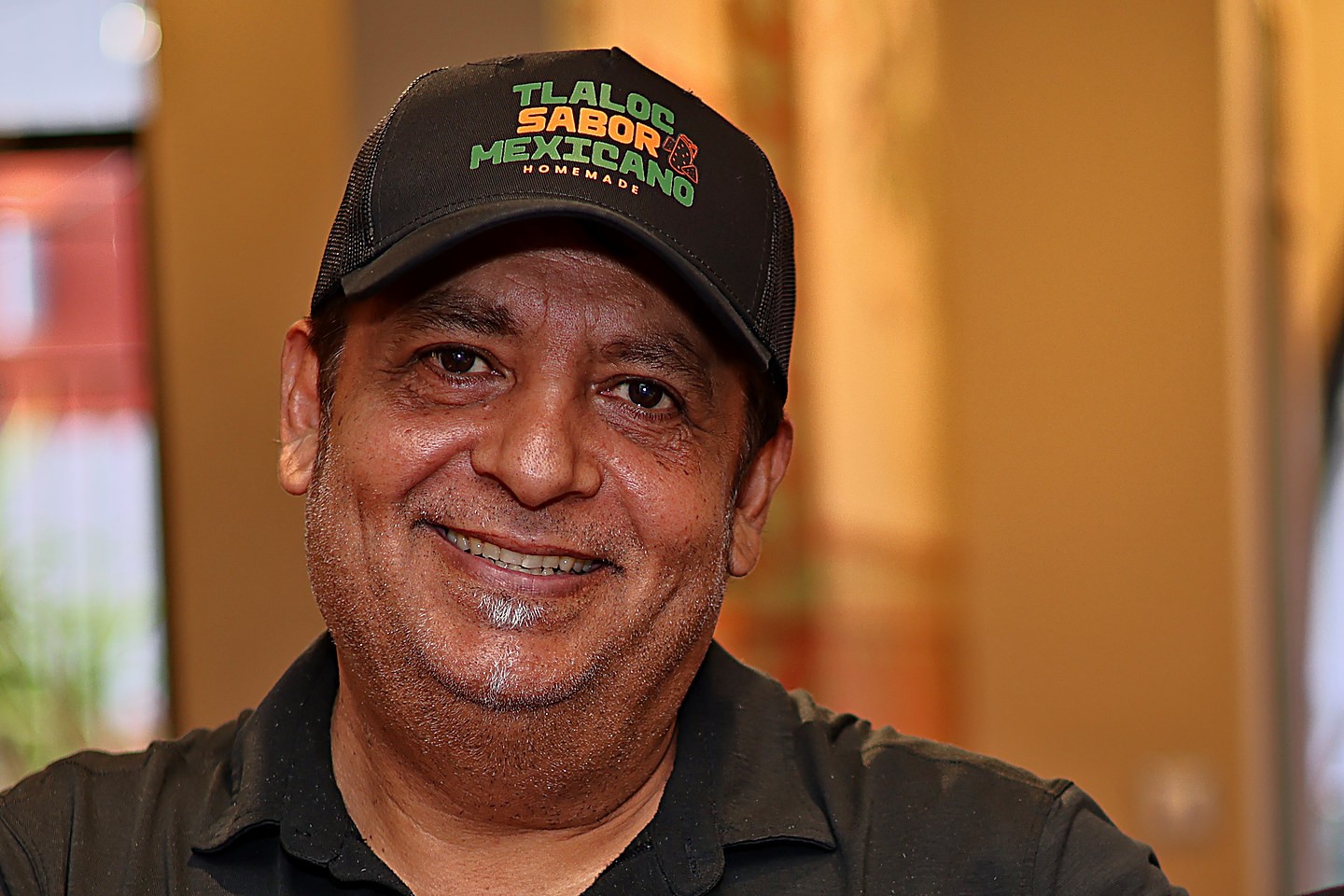
The cap front print, 3.5 inches wide. Every line in the mark has to survive at that size.

Both lockups on our actual-size sheet. We check the mark at print width in the file, before it reaches a garment.
This brand had an advantage: its brand book already included a circular badge version of the mark built for small applications, alongside the horizontal lockup. That is exactly the foresight that saves an apparel job. If your brand does not have one, that work happens now, before the order, not after the first sample comes back unreadable.
4. Which garment makes the design work?
Garment color comes first, because it decides how the art has to be built. This program went black across every piece, which meant one set of art files worked on the tee, the cap, and the apron with no rework. Before anything was ordered, we showed the same designs on natural, black, and tan so the decision was made looking at the options side by side rather than in the abstract.
Then the garment itself. Fabric weight, cut, and fit change how a print sits and how long the piece stays in rotation, which is the difference between apparel that gets worn and apparel that ends up in a drawer. Every piece should be specified by style number on the quote, not described as “a black t-shirt”.
5. How many pieces do you need, and by when?
Quantity changes the method, the price per piece, and the timeline, so it belongs in the first conversation and not the last. This order came in under 200 pieces across three garment types and two brands, which is exactly the range where heat transfer earns its place: no setup penalty for splitting a run between two logos.
Whatever the size, ask for a proof before production. Ours is an e-proof that confirms the item, the print location, the print size, and the colors, with the artwork shown at actual size. It is the last cheap moment to catch a mistake. After that you are catching it on 200 shirts.

The e-proof for the tee. Left chest at 3.5 inches, full back at 11 inches, both in CMYK, approved before anything is pressed.
What this looks like as a project
Our part starts before the art and does not stop at the file. We extend the brand onto the material, which is its own design problem and not a copy and paste of the logo. Then comes the part nobody sees: rebuilding the mark as vector art that holds at 3.5 inches, separating it for the press, laying out the transfer sheets, and putting the whole thing on an e-proof at actual size. Then we specify the garments and manage production with our vendors, so what arrives is finished pieces and not artwork you still have to get made.
The last decision is usually the one nobody plans for: the brand does not stop at the shirt. The same system went onto the tote bags customers carry out and the table tents on every table, so the work shows up where people are already looking.
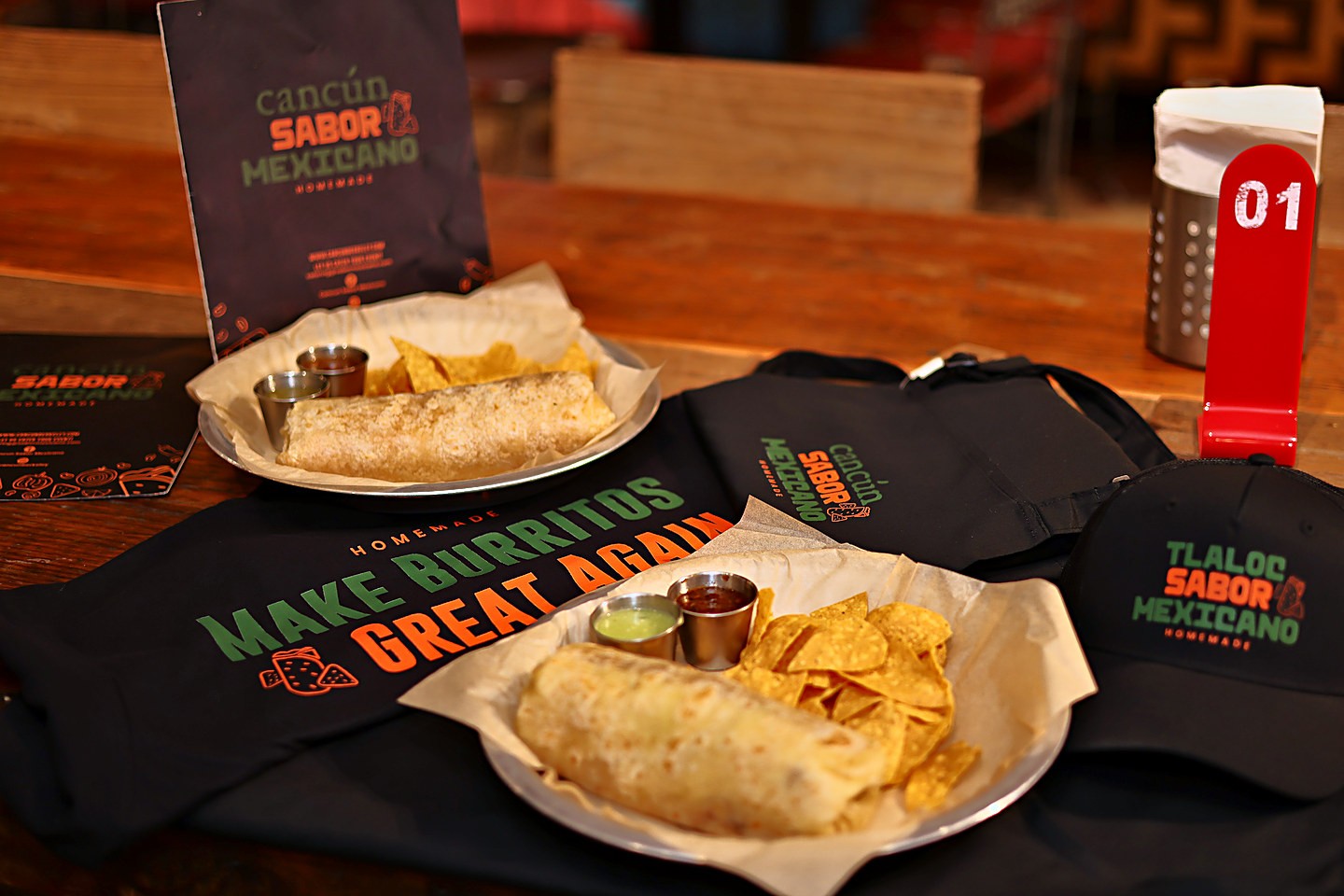
The same brand system on the table, the apparel, and the bag customers carry out.